ENG
KOR
Gimpo Int. Airport International Terminal Interior Design
Gimpo Int. Airport International Terminal Interior Design
Gimpo Int. Airport International Terminal Interior Design
2023
2023
-
-
Interior Design
Interior Design
Gimpo International Airport is Korea's first international airport, having evolved alongside Korea's modern and contemporary history.
In April 1958, it was officially designated as an international airport. For the 1988 Seoul Olympics, the current international terminal was completed, and in 1989, with the liberalization of overseas travel for all citizens, Gimpo solidified its position as South Korea's premier international airport.
However, after the completion of Incheon International Airport in 2001, Gimpo faced an identity crisis as the sole international passenger terminal in the capital region and experienced a significant decline in users, leading to a crisis for the international passenger terminal.
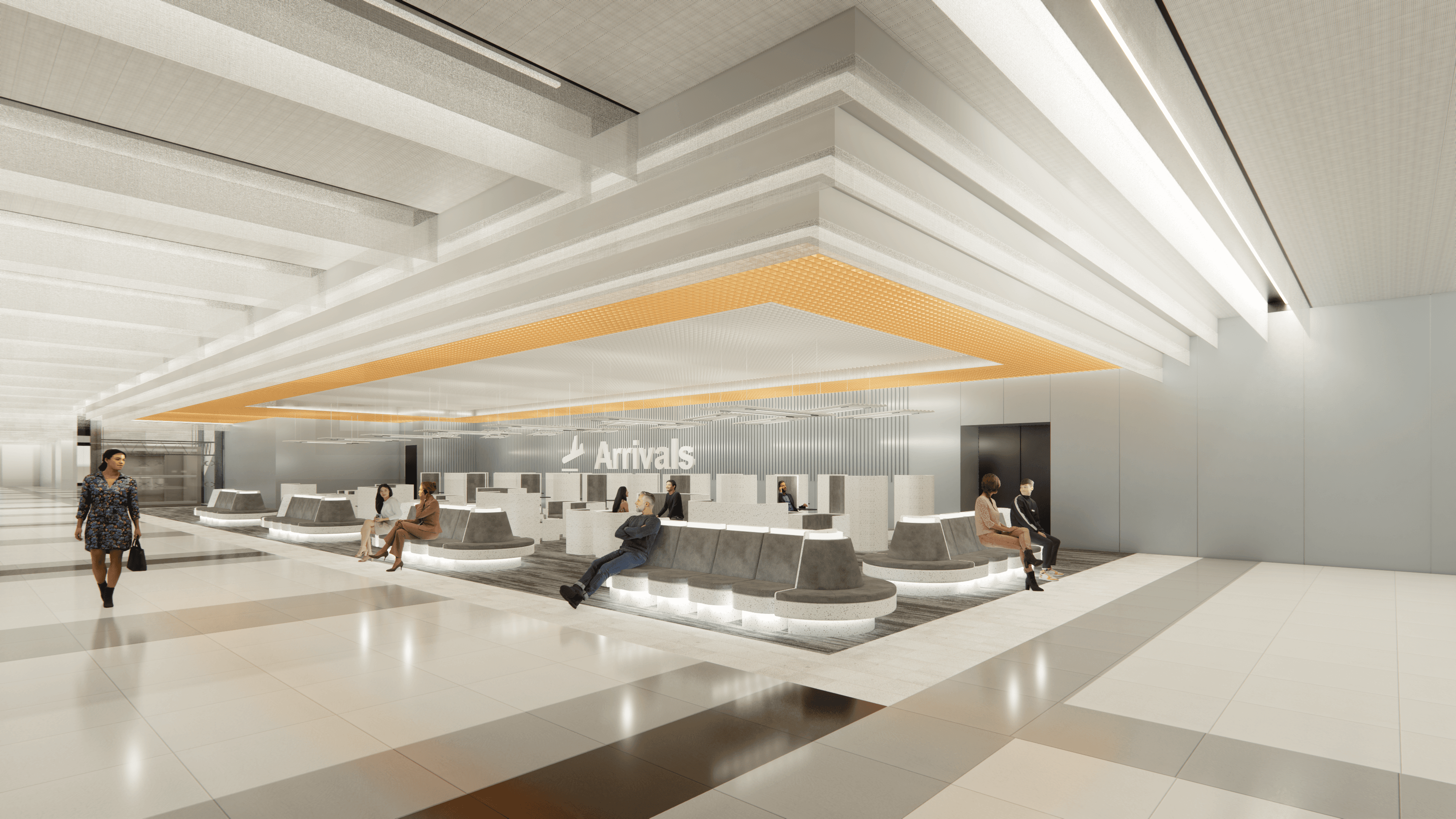
Unlike the domestic passenger terminal, which underwent a complete remodeling in 2018, the international passenger terminal, completed in 1988, had never been fully renovated under a cohesive design direction. Its current appearance lacked a consistent identity. The comprehensive concept design for Kimpo International Airport's international passenger terminal, undertaken recently, aims to establish a unified and consistent identity for the terminal in preparation for the phased improvement of the terminal's interior spaces planned for 2024 to 2026.
The identity of the international passenger terminal was found in the location of the airport, that is, its regional characteristics.
The international terminal, being the only international airport connected to Seoul, the capital of South Korea, by subway, was recognized as needing to publicly uphold its identity as Seoul's business airport.
This approach was deemed essential for the sustainable development and competitive enhancement of the airport. In line with this, the design was carried out to reflect the dignity and elegance befitting Seoul's representative business airport, while also ensuring the design was sustainable, not overly sensitive to trends, and suitable for a public transportation space.
Gimpo International Airport is Korea's first international airport, having evolved alongside Korea's modern and contemporary history.
In April 1958, it was officially designated as an international airport. For the 1988 Seoul Olympics, the current international terminal was completed, and in 1989, with the liberalization of overseas travel for all citizens, Gimpo solidified its position as South Korea's premier international airport.
However, after the completion of Incheon International Airport in 2001, Gimpo faced an identity crisis as the sole international passenger terminal in the capital region and experienced a significant decline in users, leading to a crisis for the international passenger terminal.
Unlike the domestic passenger terminal, which underwent a complete remodeling in 2018, the international passenger terminal, completed in 1988, had never been fully renovated under a cohesive design direction. Its current appearance lacked a consistent identity. The comprehensive concept design for Kimpo International Airport's international passenger terminal, undertaken recently, aims to establish a unified and consistent identity for the terminal in preparation for the phased improvement of the terminal's interior spaces planned for 2024 to 2026.
The identity of the international passenger terminal was found in the location of the airport, that is, its regional characteristics.
The international terminal, being the only international airport connected to Seoul, the capital of South Korea, by subway, was recognized as needing to publicly uphold its identity as Seoul's business airport.
This approach was deemed essential for the sustainable development and competitive enhancement of the airport. In line with this, the design was carried out to reflect the dignity and elegance befitting Seoul's representative business airport, while also ensuring the design was sustainable, not overly sensitive to trends, and suitable for a public transportation space.